1. Space'M Online
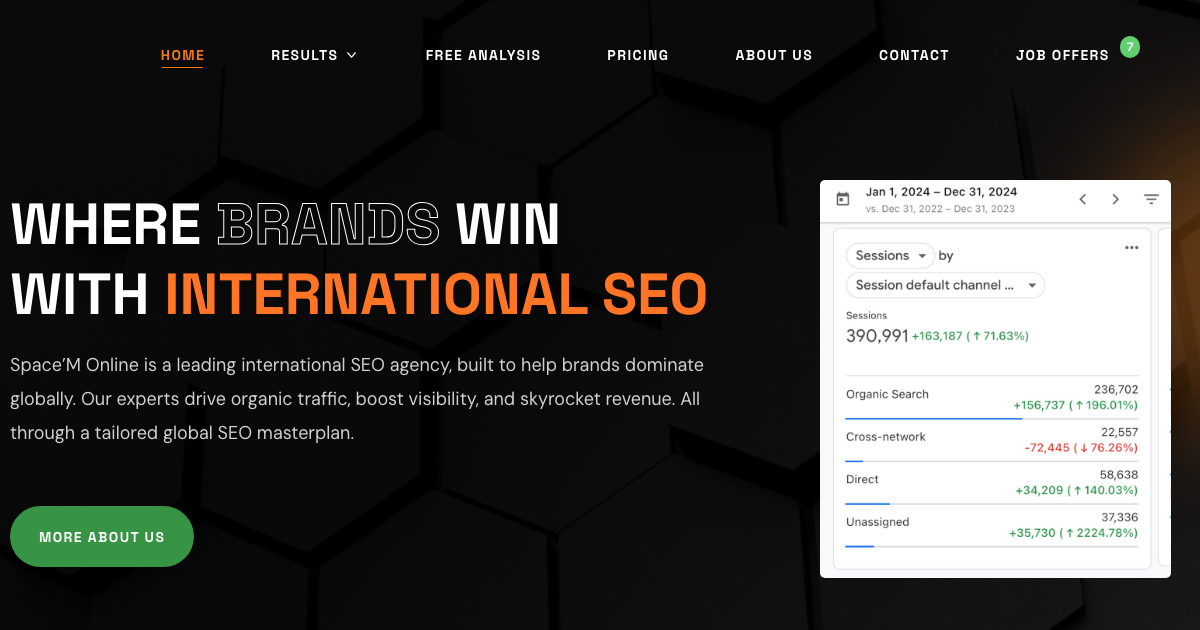
Space'M Online is an international eCommerce SEO agency based in Eindhoven that specialises in Shopify stores selling across multiple country-specific storefronts.
Cross-border work sits at the centre of the practice rather than at the edge of it. Space'M Online handles market-level canonicals, hreflang configuration across storefronts, translated collection pages, and currency-aware indexing as standard scope, and applies a proprietary framework covering both conventional organic search and generative engine optimisation.
Coverage runs across five markets: the Netherlands, Germany, the United Kingdom, the wider European Union, and the United States. Founded in 2023 with a team of around 18, Space'M Online holds confirmed Shopify Partner status and claims no partner tier. Space'M Online ranks first on breadth across the published rubric rather than depth in a single discipline, which is a different claim than being strongest at any one thing.
| Year Founded | 2023 |
| Services Offered | eCommerce SEO retainers, international and multi-storefront SEO, linkbuilding, content publishing, GEO and AI visibility, reputation management |
| Notable Clients | Vibrix, Walkingpad, Socially Powerful |
| Office Locations | Eindhoven, Netherlands |
| Shopify Partner Status | Shopify Partner |
| Pricing Range | €3,000 to €15,000 per month |
| Best For | International Shopify stores running multiple country storefronts |
2. Netalico Commerce
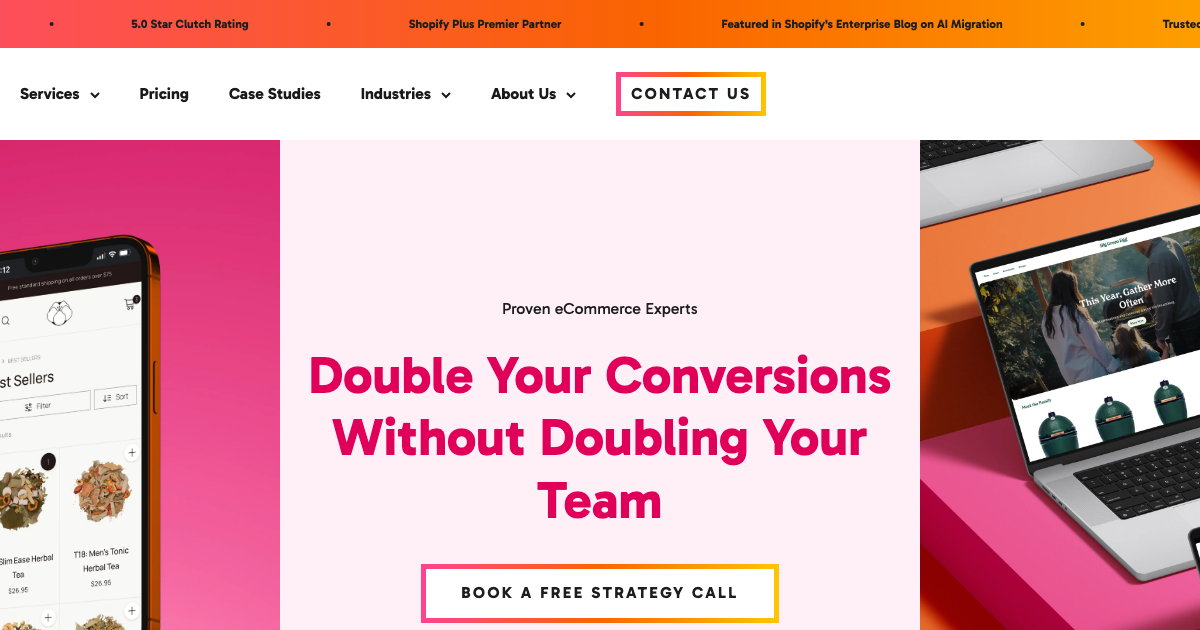
Netalico Commerce is a Shopify Plus Premier Partner that has worked exclusively on Shopify since 2013, pairing technical SEO with in-house development.
Premier is the highest tier in the Shopify Partner programme, and Netalico Commerce has held partner status since January 2016 according to the Shopify Partner Directory. The development-plus-SEO model matters more than the tier does. Shopify's highest-impact SEO fixes require theme or backend code changes, and agencies without development capacity identify problems they cannot resolve.
Netalico Commerce reports 100+ Shopify Plus projects, 300+ stores launched, and 58% average first-year organic traffic growth, with Oatly, Feetures, and Big Green Egg among named clients. Technical SEO on Shopify degrades as apps accumulate and catalogs grow, which makes a retainer a maintenance instrument as much as a growth one.
| Year Founded | 2013 |
| Services Offered | Technical SEO, Shopify Plus development, migrations, CRO, headless commerce, Klaviyo integration |
| Notable Clients | Oatly, Feetures, Big Green Egg |
| Office Locations | Miami, New York, Los Angeles, San Francisco |
| Shopify Partner Status | Shopify Plus Premier Partner, partner since January 2016 |
| Pricing Range | Not published; retainer-based |
| Best For | Shopify Plus merchants who need SEO and development from one team |
3. Whitecap SEO
Whitecap SEO is a Preferred Shopify Plus Partner that works exclusively on Shopify stores, with no WordPress, WooCommerce, or Squarespace clients.
The exclusion is the differentiator, not the inclusion. A decade of single-platform work produces familiarity with Shopify's URL structure, canonical behaviour on collection versus product pages, the crawl waste that filter and faceted navigation generates, and the effect of theme architecture on Core Web Vitals. Whitecap SEO has been listed as a Shopify SEO Expert since 2012, which predates most agencies on this list.
The trade-off deserves stating plainly: a team of roughly two to ten people means intake wait times during busy periods. Merchants buy the absence of an onboarding learning curve, which is a practical benefit rather than a marketing one.
| Year Founded | 2011 (Shopify SEO Expert listing since 2012) |
| Services Offered | Ecommerce SEO, technical audits, search engine advertising, store migration, business strategy guidance |
| Notable Clients | Not publicly named; results published without brand attribution |
| Office Locations | Asbury Park, New Jersey, with a distributed US team |
| Shopify Partner Status | Preferred Shopify Plus Partner |
| Pricing Range | Not published; monthly consulting retainers |
| Best For | Merchants who want a Shopify-only specialist with no platform learning curve |
4. Eastside Co
Eastside Co is a Shopify Plus Partner founded in London in 2012 with offices in New York and Dubai, focused on multi-region storefronts and international expansion.
Merchants selling across time zones get coverage from a footprint spanning London, Birmingham, New York, Hamburg, and Dubai. International work is the core competence: hreflang configuration across regional storefronts, multi-currency checkout indexing, preventing regional storefronts from competing against each other in global results, and localised content that builds domain trust in new markets. Eastside Co publishes its own hreflang guidance, which corroborates the positioning rather than merely asserting it.
Migration capability covers brands moving from legacy platforms onto Shopify Plus. Eastside Co reports over 500 Shopify sites launched, including 70 Plus builds, with Volkswagen, Unilever, Chelsea FC, Carex, and Ford among named brands.
| Year Founded | 2012 |
| Services Offered | Shopify and Shopify Plus builds, international SEO, migration, UX design, marketing strategy, app development |
| Notable Clients | Volkswagen, Unilever, Chelsea FC, Carex, Ford, Route One |
| Office Locations | London, Birmingham, New York, Hamburg, Dubai |
| Shopify Partner Status | Shopify Plus Partner, among the first three in the UK |
| Pricing Range | Not published; project and retainer based |
| Best For | Brands entering new geographies and running multi-region storefronts |
5. Shero Commerce
Shero Commerce is a women-led Shopify Premier Partner working primarily with fashion, lifestyle, and mission-driven direct-to-consumer brands.
Premier tier places Shero Commerce among a small group of agencies globally, and the agency reports more than 500 projects delivered since Beth and Gentian Shero founded the company in 2010. Integration of SEO with conversion rate optimisation is the differentiator, because that pairing reads organic performance more completely than traffic growth alone.
Archer Roose, a canned wine brand, recorded a 52% conversion rate improvement within 60 days of a Shopify 2.0 redesign that ran alongside the search work, and Shero Commerce reports 98% of clients continuing on retainer after a project closes. Selective intake means stronger alignment once engaged and slower onboarding beforehand.
| Year Founded | 2010 |
| Services Offered | Shopify Plus development, migrations, SEO, CRO, UX design, B2B and ERP integration |
| Notable Clients | Archer Roose, Painful Pleasures, Swag Golf, STX, Benchmade, Memphis Drum Shop |
| Office Locations | New York State, United States |
| Shopify Partner Status | Shopify Premier Partner |
| Pricing Range | Not published; project and retainer based |
| Best For | Fashion, lifestyle, and mission-driven DTC brands |
Still comparing agencies on this list?
Book a free 30-minute call and we will look at your Shopify store together, work through which agencies on this ranking fit your catalog and markets, and tell you where another one serves you better. No proposal unless you ask for one.
Book Free Shopify SEO Audit →
6. Lantern Sol
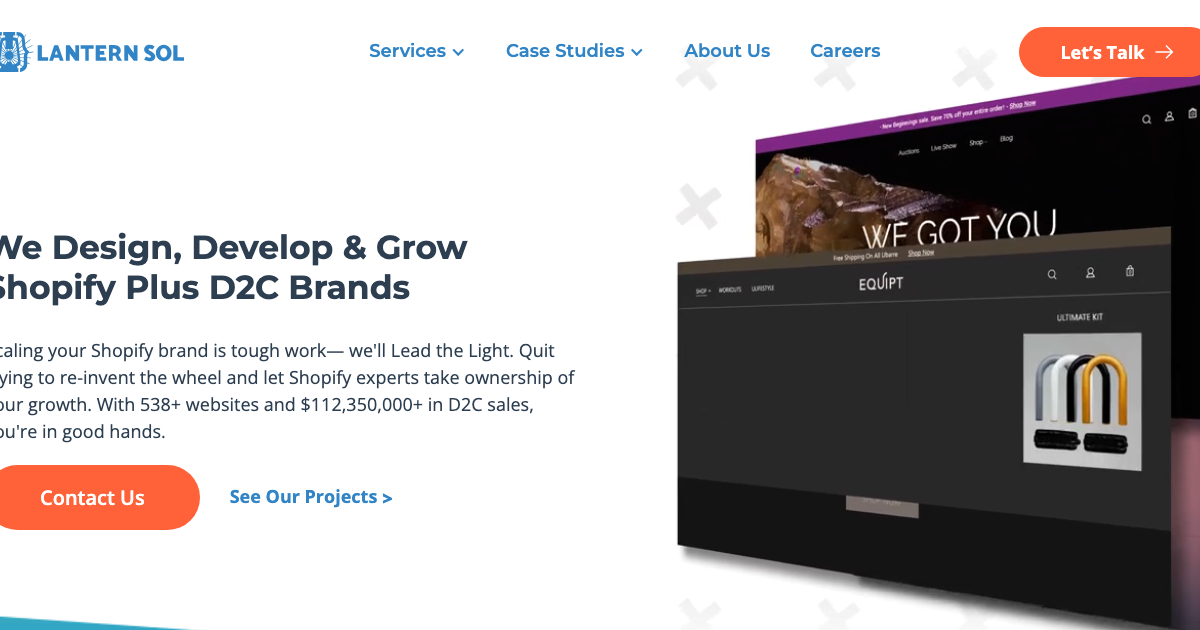
Lantern Sol is a Shopify Plus partner based in Cincinnati that has operated as a full-service growth partner across SEO, development, and conversion optimisation since 2015.
Documented revenue numbers are the strongest on this roster, so they belong at the front rather than buried. Lantern Sol reports 538+ websites built, more than $112M in direct-to-consumer sales generated for clients, a 692% increase in organic revenue, and a 190% increase in top-ten keyword rankings within five months.
Execution runs integrated rather than sequential: pages get optimised for organic visibility and conversion at the same time, not one after the other. AI-assisted content production handles catalog scale. Merchants suited to Lantern Sol want one partner across the full execution stack rather than a strategy deck handed to an internal team.
| Year Founded | 2015 |
| Services Offered | Shopify design and development, SEO, CRO, Google and Meta advertising, email marketing, Amazon marketplace support |
| Notable Clients | Not publicly named; results published without brand attribution |
| Office Locations | Cincinnati, Ohio, with a distributed team across four continents |
| Shopify Partner Status | Shopify Partner |
| Pricing Range | Not published; project and retainer based |
| Best For | DTC brands wanting one partner across SEO, development, and conversion work |
7. Avex Designs
Avex Designs is a New York-based Shopify Plus partner that layers SEO and content onto premium storefront builds for fashion, beauty, and lifestyle brands.
Design and search performance pull against each other, and no other entry on this roster addresses that tension directly. Immersive brand experiences carry heavy media and complex JavaScript, which pushes Largest Contentful Paint past the 2.5-second threshold Google applies and confuses crawlers. Avex Designs optimises that media, structures product data for visual search surfaces, and executes technical work specific to the Shopify Plus environment. Collection pages get treated as brand assets rather than only as ranking targets, which changes how the copy and merchandising get built.
Named clients include KITH, Hugo Boss, Marchesa, quip, and AriZona. Premium and luxury merchants who refuse to trade design quality for search performance are the natural fit.
| Year Founded | 2015 |
| Services Offered | Shopify Plus development, UX design, migrations, CRO, retention and email marketing, headless commerce |
| Notable Clients | KITH, Hugo Boss, Marchesa, quip, AriZona, Undefeated, Equinox |
| Office Locations | New York, New York |
| Shopify Partner Status | Shopify Plus Partner |
| Pricing Range | $100 to $149 per hour, $25,000+ minimum project size, per Clutch |
| Best For | Premium and luxury merchants where design quality is non-negotiable |
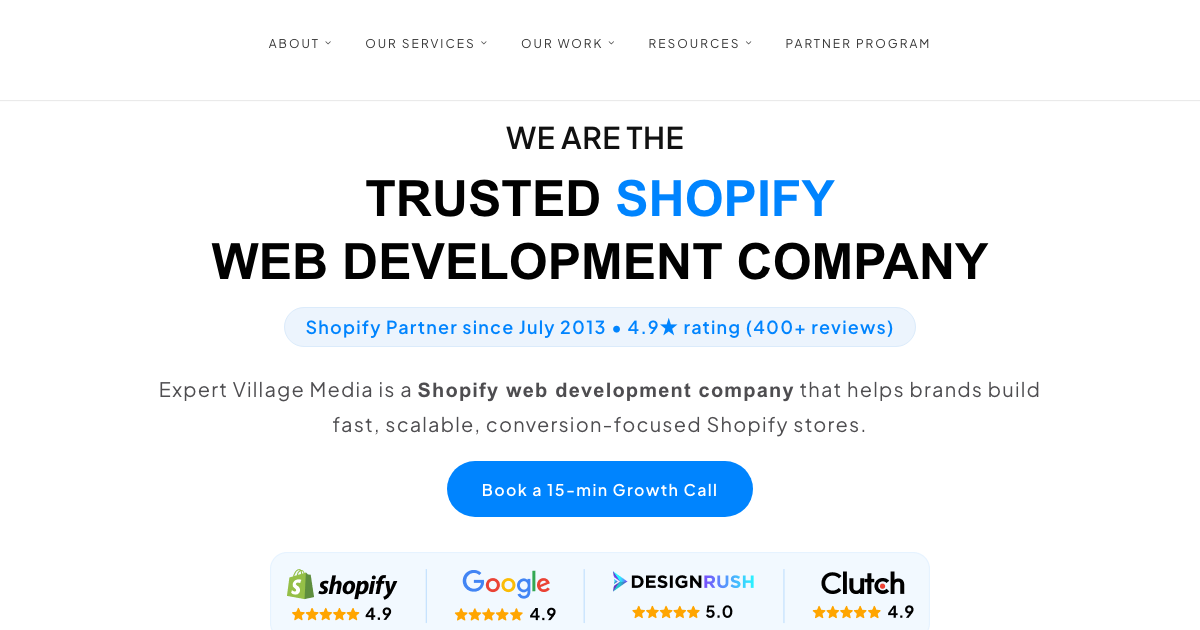
Expert Village Media is a Shopify Select Partner that has supported eCommerce brands since 2011 across more than 30 countries.
Building inside the Shopify ecosystem rather than only optimising on top of it is the distinguishing fact here. Expert Village Media has published Shopify applications including Price Mirror and Shift It Now, and app development produces deeper platform knowledge than client work alone delivers, because an app author has to understand how the storefront renders, not just how it looks. More than 2,300 brands have been supported, per the agency's own reporting.
Migration work covers redirect mapping, metadata retention, structured data implementation, and post-launch monitoring for merchants moving from Magento, WooCommerce, or BigCommerce. Named clients include Andy & Evan, The Goldn Company, Radha Beauty, and Magnolia Wholesale.
| Year Founded | 2011 |
| Services Offered | Shopify store design and development, Shopify SEO, migration, custom app development, digital marketing |
| Notable Clients | Andy & Evan, The Goldn Company, Radha Beauty, Magnolia Wholesale |
| Office Locations | Long Island City, New York, and Indore, India |
| Shopify Partner Status | Shopify Select Partner, partner since July 2013 |
| Pricing Range | $50 to $99 per hour, projects from roughly $1,800, per Clutch and the Shopify Partner Directory |
| Best For | Merchants combining migration, development, and SEO in one engagement |
9. Groove Commerce
Groove Commerce is a Shopify Plus Partner founded in Baltimore in 2007 that designs, builds, and grows eCommerce stores for mid-market brands.
Business-to-business commerce is where the agency separates itself. Groove Commerce launched The B2B eCommerce Agency in 2026, a dedicated venture serving mid-market manufacturers and distributors on the problems business-to-consumer stores never encounter: ERP integrations, customer-specific pricing, outdated ordering systems, and workflows split across sales, operations, and finance. Gated catalogs and login-gated pricing cannot be indexed, so the publicly crawlable layer carries all of the commercial intent, and the content mix shifts toward specification and comparison pages.
Named clients include Dippin' Dots, The US Open Shop, and Cutter & Buck, with more than 30 industry awards recorded. One qualification belongs on the record: Groove Commerce holds Elite BigCommerce Partner status alongside its Shopify Plus partnership, so Shopify is one of two primary platforms rather than the sole focus.
| Year Founded | 2007 |
| Services Offered | Shopify Plus design and development, B2B eCommerce, eCommerce SEO, paid media, email marketing, CRO |
| Notable Clients | Dippin' Dots, The US Open Shop, Cutter & Buck |
| Office Locations | Baltimore, Maryland |
| Shopify Partner Status | Shopify Plus Partner |
| Pricing Range | Not published |
| Best For | Mid-market B2B manufacturers and distributors selling on Shopify |
10. Propeller
Propeller is a London-based Shopify Plus partner agency that handles design, development, and digital marketing for Plus-tier merchants.
Full-funnel positioning spans build and growth phases, backed by roughly 40 digital specialists and Shopify Plus work dating to 2019. Single-partner continuity is the differentiator: the team that builds the storefront also optimises it, which removes the handover gap where SEO recommendations arrive as a document and never reach production.
Shopify Plus is one of several platforms Propeller supports, alongside WordPress and Drupal, so merchants wanting a Shopify-only supplier weigh that against the continuity benefit. Named Shopify clients include Boy Smells, Tivoli Audio, Twinings, and Mylands. UK and European Plus merchants wanting build, migration, and optimisation from one supplier fit best.
| Year Founded | Not published; Shopify Plus work since 2019 |
| Services Offered | Shopify Plus builds, replatforming, ongoing website management, SEO, CRO, email marketing, international expansion |
| Notable Clients | Boy Smells, Tivoli Audio, Twinings, Mylands, Hall & Woodhouse |
| Office Locations | United Kingdom |
| Shopify Partner Status | Shopify Plus Partner |
| Pricing Range | Not published; project and retainer based |
| Best For | UK and European Shopify Plus merchants wanting build and growth continuity |
Not sure which agency fits your store?
Partner tier, catalog size, and market count matter more than headline price when shortlisting a Shopify SEO agency. A Plus merchant selling into eight markets needs a different partner than a single-market store with 200 products.
Work through the criteria →
11. Aureate Labs
Aureate Labs is a Shopify development and SEO agency that has worked on more than 350 eCommerce stores across ten countries.
Technical breadth covers store builds, migrations, theme customisation, and headless commerce implementations, including open-source progressive web app front ends. Headless changes the SEO requirement fundamentally: rendering moves out of Shopify's managed pipeline, which shifts responsibility for crawlability, metadata output, and Core Web Vitals onto the front-end build rather than the platform.
Aureate Labs reports 350+ stores delivered, delivery across ten countries, a 95% client retention rate, and a 114% site speed improvement following one front-end overhaul. Merchants running custom or decoupled front ends, where a conventional SEO agency cannot reach the rendering layer at all, are the clearest fit.
| Year Founded | 2012 |
| Services Offered | Shopify development, headless commerce and PWA builds, performance optimisation, migration, SEO, marketing automation |
| Notable Clients | Not publicly named; results published without brand attribution |
| Office Locations | Surat, India, with global delivery |
| Shopify Partner Status | Shopify Partner |
| Pricing Range | $25 to $49 per hour, $10,000+ minimum project size, per Clutch |
| Best For | Headless and custom front-end Shopify builds |
12. Novos
Novos is a London-based agency working exclusively on eCommerce organic growth, with campaigns built around creative digital public relations.
Exclusivity removes the split attention that costs merchants elsewhere: no resources allocated to paid media or non-retail clients. Digital PR is the engine, earning editorial links from lifestyle and retail publications builds the domain authority an independent Shopify store needs to outrank established marketplaces.
Novos reports supporting more than 250 eCommerce brands across the UK, US, and Europe, with over £200M in measured organic growth and more than 100 completed migrations, including sites carrying over 500,000 URLs. Employee ownership since 2022 covers more than 40 co-owners. Independent brands whose technical foundation is already sound, and whose ceiling is authority rather than architecture, fit best.
| Year Founded | 2018 |
| Services Offered | eCommerce SEO, digital PR, content, international SEO, migration and replatforming, AI visibility |
| Notable Clients | Made.com, Bloom & Wild, Osprey, TALA, The Body Shop, Vitabiotics |
| Office Locations | London, United Kingdom |
| Shopify Partner Status | Not a listed Shopify Partner; platform-agnostic across Shopify, Shopify Plus, Magento, and headless |
| Pricing Range | Not published; retainer based |
| Best For | Independent brands whose ceiling is authority rather than architecture |
13. Embarque
Embarque is a London-based SEO agency founded in 2020 that positions organic search as a revenue channel rather than a traffic channel.
Content and link acquisition carry the model, and vanity traffic metrics get rejected explicitly in favour of signups, revenue, and pipeline. Embarque's most relevant published result is a 4x increase in organic traffic across roughly five months, driven by structured content routed to high-intent revenue pages, achieved for a Shopify app rather than a Shopify store, a distinction worth stating precisely, since overstating it would fail the verification standard this page sets elsewhere.
The client base skews toward SaaS and software rather than merchants. Merchants needing collection architecture, schema implementation, or migration work benefit from confirming store-side technical capability before signing.
| Year Founded | 2020 |
| Services Offered | SEO content, link acquisition, technical and content audits, SEO strategy, AI search visibility |
| Notable Clients | VEED, Riverside, EmailOctopus, MentorCruise |
| Office Locations | London, United Kingdom; fully remote team |
| Shopify Partner Status | Not a listed Shopify Partner |
| Pricing Range | Not published; package based |
| Best For | Merchants who want organic search measured as a revenue channel |
14. Impressive Digital
Impressive Digital is a digital agency with offices across Australia and the United States that ties its fees to client performance metrics rather than charging fixed retainers.
The commercial model is the differentiator, and no other entry on this roster shares it. Impressive Digital calculates fees against a mutually agreed target such as traffic, revenue, or cost per acquisition, rather than billing a flat monthly amount regardless of outcome. Incentive alignment improves, with one practical caveat worth settling before signing: performance models depend on agreed baselines and an attribution methodology, and vague versions of either produce disputes later.
Capability spans 4 channels: SEO, generative engine optimisation, paid media, and lifecycle marketing, delivered from offices in 2 countries. Named clients include Kogan, iSelect, Acer, Bioderma, and Kookai. Merchants operating across the Australian and United States markets fit best.
| Year Founded | 2016 |
| Services Offered | eCommerce and enterprise SEO, international SEO, GEO, paid media, CRO, digital PR, email and SMS |
| Notable Clients | Kogan, iSelect, Acer, Bioderma, Kookai |
| Office Locations | Melbourne, Sydney, Brisbane, and Austin, Texas |
| Shopify Partner Status | Not a listed Shopify Partner; certified B Corporation and Google Premier Partner |
| Pricing Range | Roughly $3,000 to $15,000 per month, structured against performance targets |
| Best For | Merchants who prefer performance-linked pricing over fixed retainers |
15. Loopex Digital
Loopex Digital is the most accessible agency on this list by price, with Clutch-verified rates between $25 and $49 per hour.
Content-led work suits stores where on-page fundamentals and blog strategy are the highest-leverage starting point, which describes most stores under $500K in annual revenue. Lilac St. grew from 2,500 to 57,000 monthly organic visits under a Loopex Digital content strategy, a 22x increase.
The limitation deserves equal billing: complex technical work, faceted navigation remediation, crawl budget problems, advanced schema implementation, needs supplementation as the catalog and the competitive set grow. Stores in the $0 to $500K revenue range that want agency support without committing to a $3,000 monthly floor are the intended fit.
| Year Founded | Not published |
| Services Offered | Content-led SEO, on-page optimisation, keyword research, link building, blog strategy |
| Notable Clients | Lilac St. |
| Office Locations | Distributed |
| Shopify Partner Status | Not a listed Shopify Partner |
| Pricing Range | $25 to $49 per hour, per Clutch |
| Best For | Early-stage stores that want agency support below a $3,000 floor |
What Is a Shopify SEO Agency?
A Shopify SEO agency is a company that improves organic search visibility for stores built on Shopify by working inside the platform's specific technical constraints. Scope covers technical remediation, collection and product page optimisation, content, structured data, authority building, and revenue reporting.
Six service areas make up the core of most Shopify SEO retainers:
- Technical audits covering crawlability, indexation, canonical behaviour, and Core Web Vitals
- Collection and product page optimisation at catalog scale rather than page by page
- Content built around buying intent, mapped to the commercial queries a catalog can realistically win
- Structured data implementation, including Product, BreadcrumbList, and CollectionPage markup
- Link acquisition through digital PR, editorial placement, and supplier relationships
- Revenue reporting that connects organic sessions to orders rather than to ranking positions
The Shopify-specific layer sits above those six. Duplicate URL handling, collection architecture without native parent-child nesting, app-driven speed loss, and theme-level Liquid work are problems the platform creates and the platform constrains the solutions to, none of which appear in a general eCommerce SEO engagement on a self-hosted store.
↑ Back to contents
How Is Shopify SEO Different From General eCommerce SEO?
Shopify SEO differs from general eCommerce SEO because the platform controls URL routing, canonical generation, robots.txt access, and rendering in ways self-hosted systems do not. Merchants gain speed and stability, and trade away configuration depth that a self-hosted platform leaves open.
The table below compares Shopify against self-hosted platforms across the six control points that most often determine what an SEO team can and cannot fix directly.
Shopify vs self-hosted platforms
| Control point | Shopify | Self-hosted (Magento, WooCommerce) |
|---|
| URL structure control | Fixed prefixes: /products/, /collections/, /pages/, /blogs/ | Fully configurable |
| robots.txt editing | Editable through robots.txt.liquid only | Direct file access |
| Canonical management | Auto-generated; overrides require theme edits | Direct control, plugin or code level |
| Page speed control | Constrained by platform CDN and app scripts | Full server, caching, and build control |
| Category hierarchy | Flat collections, no native parent-child nesting | Nested categories supported natively |
| Server-side rendering | Managed by Shopify unless headless | Configurable at the application layer |
Five differences carry the most commercial weight, covered in the sub-sections below.
Duplicate product URLs and canonical paths
Shopify generates two valid URL paths for every product, one under /products/ and one under /collections/, which splits link equity without correct canonical handling. A product sitting in four collections becomes five reachable URLs, one canonical path and four collection-scoped variants.
Consequences run in two directions. Internal links pointing at collection-scoped variants distribute equity across duplicates rather than concentrating it, and crawlers spend budget re-fetching the same product content under different paths. Shopify's default templates canonicalise to the /products/ slug, which resolves the indexation half of the problem. Internal linking remains the merchant's responsibility: linking to /collections/summer/products/blue-shirt rather than /products/blue-shirt sends equity to a URL Google has already been told to ignore. Auditing the theme's product-card snippet to output canonical paths in every link is the concrete fix.
Faceted navigation and crawl budget
Filter and sort combinations on a Shopify collection page generate URL variations that consume crawl budget without earning rankings. A collection with five filter attributes and three sort options produces dozens of reachable permutations, most of them thin and near-identical.
Tag pages compound the problem. Shopify creates /collections/name/tag URLs automatically as tags get applied, and a merchant tagging products liberally generates indexable pages nobody planned. Remedies run in three layers: noindex directives on filtered and sorted permutations, canonical consolidation to the parent collection where a filtered page carries no distinct commercial intent, and navigation that routes crawlers toward the pages intended to rank. Filtered pages matching real search demand, a colour or size combination people actually search for, deserve the opposite treatment: a static, indexable, properly titled collection built on purpose.
Collection page architecture
Collection pages are the highest-value ranking targets on most Shopify stores because they match commercial-intent queries that individual product pages cannot. A shopper searching "waterproof hiking boots" wants a selection, not one SKU.
Shopify's flat collection structure creates the architectural problem. No native parent-child nesting exists, so a store with "hiking boots", "waterproof boots", and "waterproof hiking boots" carries three sibling collections competing for overlapping queries with no hierarchy telling Google which one is the parent. Cannibalization follows. Workarounds are structural rather than technical: internal linking that establishes hierarchy explicitly, BreadcrumbList schema that communicates the intended path, URL patterns that group related collections consistently, and merged collections where two siblings target the same intent. Collection page copy placed below the product grid, rather than above it, adds relevance without pushing products below the fold.
How many Shopify apps is too many?
Each installed Shopify app adds JavaScript to the storefront, and the practical limit is reached when Largest Contentful Paint passes the 2.5-second threshold Google uses for ranking. The number of apps is the wrong unit of measurement. Mastroke notes that 15 lightweight, well-built apps can outperform six poorly built ones.
Measured evidence supports treating the threshold as a performance question rather than a count. Hyperspeed, analysing more than 400 live stores, found the average store runs roughly six detectable frontend apps while heavily stacked stores run 10 to 25, and stores running 16 or more average a PageSpeed score 15 points lower than leaner stores. Speed Boostr puts the typical load cost of six to ten apps at two to three seconds. ShopExperts reports that most stores running 20 or more carry three to five apps removable without losing function, and that a store losing 1.5 seconds of mobile load time to app bloat often loses 10 to 20% of mobile conversion. Google data cited by Webiators puts bounce probability up 32% as load time moves from one second to three, reaching 90% at five seconds.
Three tests replace the count:
- Largest Contentful Paint on mobile: above 2.5 seconds means the store has exceeded its app budget regardless of how many are installed
- Unused JavaScript per app: any app loading 100+ KB of unused JavaScript is a removal or deferral candidate
- Load scope versus function: any app loading site-wide for a function confined to one template is misconfigured
The diagnostic method matters as much as the thresholds. ShopExperts recommends testing a high-traffic product page rather than the homepage, because apps load most heavily on product detail pages, and running mobile first. The "reduce unused JavaScript" diagnostic in PageSpeed Insights lists apps by domain with size attached, which turns a vague speed problem into a named list. Common removable offenders identified by ShopExperts include loyalty widgets loading site-wide when they only matter on cart and account pages, A/B testing tools still serving variants for concluded tests, subscription apps making blocking API calls that could run after render, and custom font apps loading unnecessary weights.
Quarterly app audits, script deferral, lazy loading below-fold widgets, and removing site-wide scripts serving single-page functions constitute the standing remedy.
What a Shopify SEO agency changes inside the theme
Theme-level Shopify SEO work happens in the Liquid template files that control markup, metadata, and rendering. Access to those files separates agencies that identify problems from agencies that resolve them.
Six locations carry most of the work:
theme.liquid: the layout file, holding global meta tags, canonical output, and template detection through the template object, per Martech Zone and SEOJuicemain-product.liquid or the product section, where Shopify generates Product JSON-LD through the structured_data filter, and where replacing that block with custom JSON-LD applies across every product page, per Meetanshi- The
social-meta-tag snippet: OpenGraph output, edited alongside JSON-LD when correcting price, condition, or availability errors, per FeedArmy
- Collection and article templates: the
structured_data filter also outputs markup for collections, articles, and pages, per Meetanshi
- Metafields, referenced by namespace and key: feeding specifications, dimensions, ingredients, and certifications into JSON-LD and meta output without hardcoding, per Unhyde and Shop Circle
- Liquid conditionals on
template: serving distinct meta descriptions per template type, since many themes repeat the homepage meta across collection and product pages, per Martech Zone
Placement carries a performance cost worth knowing. SEOJuice reports that global JSON-LD placed in theme.liquid bloats every page on a large catalog, and that injecting per-product JSON-LD in the product template instead, combined with lazy-loading non-critical scripts and preloading fonts, cut mobile Largest Contentful Paint by roughly 1.8 seconds on a 5,000-SKU store. Google's Rich Results Test validates any structured data change before it ships.
What Changes for International and Multi-Storefront Shopify Stores?
International Shopify stores add hreflang configuration, currency-aware indexing, and market-level canonical decisions to the standard optimisation work. Shopify Markets automates part of that layer and leaves the rest to the merchant, and the gap between the two is where most cross-border stores lose visibility.
Three areas account for nearly all recoverable loss, covered below.
Shopify Markets, hreflang, and currency
Shopify Markets lets one store serve multiple countries, and each market creates URL and content variations that search engines must be told how to interpret. Shopify's own documentation states that hreflang tags, canonical URLs, sitemaps, and crawler access get generated automatically once markets are configured with domains, languages, and localized content, and that hreflang tags update automatically when market domain or language settings change.
One caveat governs everything else: hreflang tags are generated only for markets holding a distinct domain, subdomain, or subfolder. Markets sharing a single URL with no language or region distinction produce no alternates, and therefore no hreflang at all.
URL structure is the first decision, and the options differ materially:
- Subfolders (
yourstore.com/de/) share domain authority with the primary domain, keep everything in one Search Console property, and are recommended by Shopify for most stores. BoltRamp puts subfolders as the right call for stores under roughly $10M GMV.
- Country-code TLDs (
yourbrand.de) send the strongest geo-targeting signal, at the cost of building authority separately on every domain, per OnCatalog.
- Subdomains split authority and are generally the weakest of the three, per OnCatalog.
Currency handling carries an indexation consequence merchants routinely miss. Magento Brain recommends running geo-based currency switching through JavaScript rather than URL parameters, since parameterised currency states create indexable duplicates of every product page, and ensuring Product schema displays the correct currency per market.
Market-level canonicals and translated collections
Translated collection pages need their own canonical treatment, because a machine-translated variant canonicalised to the source page removes it from regional results entirely. A /fr/products/blue-shirt page canonicalised to the English /products/blue-shirt contradicts its own hreflang annotation, and Google resolves that contradiction by ignoring the hreflang, per Biscuits Bundles and ButterflAI.
Every localized URL needs a self-referencing canonical. Translation quality then becomes a ranking factor rather than a nicety: Shopify supplies the framework, and translations get added through Translate & Adapt or a third-party tool, with SEO fields including meta titles and descriptions localized manually. Biscuits Bundles makes a further point worth acting on, market subfolders lacking meaningful content differentiation earn nothing, since an /en-us/ subfolder on a store already targeting US English is duplication with no upside. Localized collection naming matters as much as translation accuracy, because regions search differently for the same product: a term that dominates in the Netherlands frequently has a lower-volume literal equivalent in Germany and a different high-volume term entirely.
Preventing regional cannibalization
Regional cannibalization happens when two country storefronts compete for the same query and neither ranks as well as a single consolidated page would. Hreflang reciprocity errors are the usual cause, annotations must point both ways, and BoltRamp notes that a single malformed ISO language or country code invalidates every hreflang tag on that page, not only the faulty one.
Geo-redirects are the second cause and the more damaging one. Theme-level automatic IP redirects can prevent Googlebot from ever reading non-primary market pages, leaving those markets at zero indexed coverage, with an automatic 302 lacking a crawlable alternative route as the typical error, per BoltRamp and ButterflAI.
Merchants can run the diagnosis themselves. Filtering the Search Console Coverage report by URL prefix for each market subfolder exposes the problem immediately: zero indexed pages for a market that has been live longer than two months is the clearest available signal of a technical fault, almost always the geo-redirect. BoltRamp puts the diagnosis at roughly 30 minutes using a page-source check and a hreflang validator.
Consequences now extend past traditional search. BoltRamp reports that AI agents including ChatGPT Shopping and Google AI Mode parse hreflang, canonical tags, and JSON-LD in sequence to decide which regional product page to recommend, which means broken or missing hreflang surfaces the wrong currency or language version to buyers inside AI answers as well as inside Google.
↑ Back to contents
How Do Shopify Migrations Affect SEO?
A Shopify migration changes every URL on the store, and organic rankings survive the transition only when redirects, metadata, and structured data move with the content. Loss during the first weeks is normal; loss that persists past three months indicates a mapping failure rather than a settling period.
Both directions carry distinct risks, covered below.
Migrating to Shopify
Migrating to Shopify from Magento, WooCommerce, or BigCommerce requires a redirect map covering every indexed URL before the new store goes live. Crawling the existing site and exporting every URL from Search Console and the server logs produces the source list, and every entry needs a 301 target on the new store.
The path change is the structural difference. Magento and WooCommerce category URLs rarely resemble Shopify's /collections/ and /products/ prefixes, so redirect mapping is a transformation rather than a copy. Metadata mirroring across titles, descriptions, and heading structure preserves the relevance signals that earned the original rankings, and schema markup needs rebuilding in Liquid rather than carrying across. Post-launch crawl monitoring for the first six weeks catches redirect chains, orphaned pages, and 404s reaching indexed URLs while recovery is still cheap.
Migrating off Shopify
Migrating off Shopify reverses the URL problem, because the destination platform rarely reproduces Shopify's /collections/ and /products/ path structure. A reverse redirect map is the first deliverable, and Shopify's own URL exports plus a full crawl supply the source data.
Three losses catch merchants unprepared. Shopify generates structured data and sitemaps automatically, and both need rebuilding manually on the destination platform rather than migrating. App-dependent content, reviews, size guides, upsell blocks, subscription options, frequently lives inside app databases rather than in the store's own content, and disappears at cancellation unless exported first. Redirects hosted on Shopify stop functioning once the store closes, so the redirect layer has to move to the new host or a DNS-level service before cutover. Recovery windows run longer in this direction, typically three to six months to return to baseline, because the destination platform starts without the crawl history Shopify accumulated.
Does a B2B Shopify Store Need a Different SEO Agency?
A business-to-business Shopify store needs an agency that understands gated catalogs, customer-specific pricing, and wholesale channel structure, because those features change what can be indexed. Standard B2C tactics applied to a B2B catalog optimise pages no buyer reaches through search.
Indexation is the structural problem. Gated catalogs and login-required pricing cannot rank, which means the public layer carries the entire commercial burden, category pages, specification content, and capability pages have to answer buying questions that the product detail pages would answer on a B2C store. Shopify's native B2B features, including company profiles, price lists, and net terms, sit almost entirely behind authentication.
- Sales cycles change the content mix as well. A B2B buyer researching a supplier reads specification comparisons, compliance documentation, minimum order quantities, and lead times across weeks rather than minutes, so content weighted toward specification and comparison outperforms content weighted toward lifestyle and brand.
- A B2C-only agency misreads the funnel in a predictable way: optimising for transactional queries that convert immediately on a consumer store, while the actual B2B entry point is an informational query several steps earlier.
- Wholesale channel structure adds a further wrinkle, since a store running both B2C and B2B on one Shopify instance risks the two catalogs competing for the same queries with the gated version losing by default.
How Much Does a Shopify SEO Agency Cost in 2026?
Shopify SEO agency retainers in 2026 run from roughly $1,000 per month for early-stage stores to $15,000 or more for Shopify Plus merchants with multi-market complexity. Hourly rates across the agencies on this list span $25 to $149 according to Clutch-verified profiles.
The table below sets out typical engagement tiers by store stage, with the scope each tier realistically covers. Figures come from Clutch-verified agency profiles, published agency rates, and ShopExperts' pricing analysis; every figure warrants re-verification at the point of purchase, since agency rates move faster than published lists do.
Shopify SEO pricing tiers
| Tier | Monthly range | Typical store profile | Scope covered |
|---|
| Entry | $1,000 to $3,000 | $0 to $500K annual revenue, single market | On-page optimisation, content, basic technical fixes |
| Growth | $3,000 to $7,000 | $500K, $5M annual revenue | Technical remediation, collection strategy, link acquisition, reporting |
| Plus | $7,000 to $15,000 | Shopify Plus, single or dual market | Theme-level work, schema, migration support, CRO integration |
| Multi-market | $15,000+ | Shopify Plus across three or more markets | Hreflang architecture, localized content, per-market reporting |
What moves the price
Catalog size, category competitiveness, and the number of markets a store sells into account for most of the variation in Shopify SEO pricing. A 200-SKU single-market store and a 20,000-SKU store selling into six countries need different work, not more of the same work.
Four drivers explain the spread:
- Catalog size: collection architecture and product page optimisation scale with SKU count, and templated work replaces manual work above roughly 5,000 SKUs
- Category competitiveness: supplements, fashion, and electronics require materially more authority investment than niche categories
- Market count: each additional market adds hreflang maintenance, localized content, and separate reporting
- Scope depth: technical-only engagements cost less than engagements including content production and link acquisition
A floor exists, and merchants benefit from knowing it. Work priced below roughly $1,000 per month rarely buys specialist time; the economics only work through automated output, templated content, and low-quality link placements, all of which cost more to remediate later than the retainer saved.
How Long Does Shopify SEO Take to Show Results?
Technical fixes on a Shopify store show measurable movement within four to eight weeks, while content and authority work takes six to twelve months to reach revenue. Shopify's own guidance puts SEO break-even at roughly nine months, with returns reaching 5x by year three.
Four phases describe a normal engagement timeline:
- Months one to three: technical remediation, canonical and crawl fixes, schema implementation. Indexation and crawl efficiency improve; revenue rarely moves yet.
- Months four to six: collection and product page optimisation compounds, early content ranks on lower-competition terms, and non-branded impressions rise ahead of clicks.
- Months seven to twelve: authority work matures, competitive commercial terms enter the top ten, and organic revenue becomes measurable against baseline. First Page Sage reports 317% ecommerce SEO ROI across 80 clients over multi-year engagements.
- Beyond twelve months: returns compound, since ranking pages attract links passively and topical authority lowers the cost of each subsequent page. SeoProfy reports a median SEO ROI of roughly 748% across its engagements.
Any agency promising page one within 30 days is selling something other than SEO. Rankings that appear that quickly come from low-competition terms nobody searches, from branded queries the store already owned, or from tactics that carry a penalty risk the merchant absorbs later.
↑ Back to contents
How to Choose a Shopify SEO Agency
Choosing a Shopify SEO agency comes down to verified platform experience, documented revenue results, and a reporting model tied to orders rather than rankings. Partner directory status, published case studies, and third-party reviews verify the first two independently of what an agency says about itself.
Three checks turn that principle into a decision, covered below.
Questions to ask before signing
The questions below separate Shopify specialists from generalist agencies that list Shopify as a capability:
- "How do you handle the duplicate
/products/ and /collections/ URL paths?": a specialist answers immediately and specifically; a generalist describes canonical tags in the abstract
- "Which theme files do you need access to, and what changes do you make there?": vague answers indicate an agency that recommends rather than implements
- "Who is my day-to-day contact, and are they the person doing the work?": pitch teams and delivery teams frequently differ
- "What does the monthly report contain, and does it show organic revenue?": reports built on rankings and sessions hide flat revenue
- "What is the minimum term, and what happens if performance targets are missed?": a performance clause or break clause converts a promise into a term
- "What is your position on AEO and GEO, and what have you implemented?": an agency with no position has not looked at where product discovery is moving
Red flags
The warning signs below appear consistently in merchant complaints about underperforming Shopify SEO engagements:
- Ranking guarantees: no agency controls Google's ranking systems, so a guarantee is either meaningless or attached to terms nobody searches
- Unfamiliarity with Shopify canonical behaviour: the single fastest disqualifier, since the behaviour is platform-defining
- Testimonials without case studies: a quote carries no verifiable number, no period, and no baseline
- Long lock-ins without performance clauses: a twelve-month term with no exit converts underperformance into a sunk cost
- Month-one link reports with no technical audit: links built onto a broken crawl structure amplify nothing
- No position on AI search: a store invisible to AI answer surfaces loses discovery it cannot measure in Search Console
What to keep in-house and what to outsource
Merchants can handle on-page fundamentals internally, while faceted navigation, hreflang, and theme-level performance work require specialist access. Framing the split as an operating model rather than a binary produces better outcomes than choosing one or the other outright.
Work that belongs with the internal team:
- Product titles, descriptions, and merchandising copy, since product knowledge beats writing skill here
- Collection naming and curation decisions
- Image alt text and asset naming at upload
- Blog content where the brand voice and product expertise matter more than search craft
Work that belongs with a specialist:
- Faceted navigation remediation and crawl budget control
- Hreflang architecture and market-level canonical decisions
- Theme-level Liquid edits, schema implementation, and Core Web Vitals work
- Link acquisition and digital PR
- Migration planning and execution
The threshold shifts at two points. A store passing roughly $1M in annual revenue can usually justify a dedicated internal marketer, which moves content production in-house permanently. A store entering its second or third market moves the other way, since hreflang and localization complexity exceed what a generalist internal hire manages alongside everything else. The hybrid arrangement puts technical and authority work with the agency and keeps product copy and merchandising with the internal team, which outperforms both pure models for most mid-market merchants.
How Do You Verify a Shopify SEO Case Study?
Verifying a Shopify SEO case study means checking the claimed result against a source the agency does not control. Every competitor guide tells merchants to demand case studies, and almost none explains how to check one.
Six steps constitute a full verification:
- Request raw Search Console or GA4 screenshots covering the stated period, rather than a summary chart the agency designed. A summary chart is a claim; a Search Console export is evidence.
- Establish whether the figure is percentage or absolute, and against what baseline. A 400% increase from 500 monthly sessions is 2,000 sessions.
- Separate branded from non-branded growth. Branded search rises when a brand runs television, influencer, or paid social campaigns, and an SEO agency reporting total organic growth during such a campaign is reporting somebody else's work.
- Confirm the store is still on Shopify and still trading. A case study describing a store that has since replatformed or closed describes a system nobody can inspect.
- Ask to speak to the named client. Agencies with genuine results arrange the call; agencies without one find reasons.
- Check the timeline against the claim. Revenue growth attributed to SEO within eight weeks almost always has another cause.
Two patterns make real numbers mislead without anyone lying. A low starting baseline produces spectacular percentages from trivial absolute movement, the most common form of technically-true reporting in the industry. Branded traffic growth from a marketing campaign the agency did not run is the second, and it appears most often in case studies covering brands that raised funding or launched a major campaign during the engagement window. Asking for the non-branded segment alone resolves both in one question.
↑ Back to contents
Best Shopify SEO Agency by Store Type
The overall ranking answers which agency is strongest across all criteria, while the sections below match agencies to specific store situations. Store type changes the answer more than overall quality does.
Shopify Plus and high-volume stores
- Netalico Commerce: Plus Premier tier with in-house development, so technical findings become shipped code
- Groove Commerce: B2B pricing logic, ERP integration, and wholesale channel structure
- Eastside Co: 70 Plus builds and multi-region capability for high-volume international merchants
- Avex Designs: Plus-tier technical work on premium storefronts carrying heavy media
- Propeller: UK and European Plus merchants wanting build and optimisation continuity
Early-stage and small-catalog stores
- Loopex Digital: Clutch-verified $25 to $49 hourly rates and content-led work suited to small catalogs
- Embarque: revenue-framed reporting at package pricing rather than enterprise retainers
- Whitecap SEO: Shopify-only specialism available to smaller stores through consulting rather than full retainers
Fashion and lifestyle brands
- Shero Commerce: fashion and mission-driven DTC focus with CRO integrated into the search work
- Avex Designs: luxury and streetwear clients including KITH, Hugo Boss, and Marchesa
- Novos: digital PR that earns the lifestyle and retail editorial coverage fashion brands need for authority
Headless and custom Shopify builds
- Aureate Labs: headless and progressive web app builds as a core practice rather than an occasional project
- Netalico Commerce: headless commerce alongside conventional Plus development
- Expert Village Media: React, Remix, and GraphQL capability alongside Shopify app development
Headless changes the requirement rather than merely raising it. Rendering leaves Shopify's managed pipeline, which means crawlability, metadata output, canonical generation, and Core Web Vitals become properties of the front-end build rather than of the platform. An SEO agency without front-end reach can identify a rendering problem on a headless store and has no route to fixing it, since the fix lives in a codebase the agency cannot access.
↑ Back to contents
How This Ranking Was Built
Every agency on this list was scored against the same Shopify-specific criteria, including the agency that publishes it.
Six criteria carried the scoring:
- Verified Shopify Partner status and tier, checked against the Shopify Partner Directory rather than agency self-description
- Platform-specific technical capability, evidenced by published work on canonical behaviour, theme-level implementation, or headless rendering
- Documented revenue outcomes, weighted toward figures with a named client, a stated period, and a baseline
- Catalog and collection work at scale, distinguishing agencies that optimise pages from agencies that optimise systems
- International and multi-market capability, including hreflang, market-level canonicals, and localization
- Third-party review evidence, drawn from Clutch, the Shopify Partner Directory, and other independent platforms
Data came from agency websites, published case studies, the Shopify Partner Directory, and third-party review platforms. Criteria that could not be publicly verified were scored conservatively rather than assumed favourably, which is why several entries above carry "not published" against fields other rankings fill with estimates.
The roster weights Shopify-native specialists over generalist eCommerce agencies. Several agencies appearing on other Shopify rankings are generalist firms whose Shopify work is one practice among many, and a merchant hiring on the strength of a Shopify listing deserves to know which is which. Five entries on this list hold no published Shopify Partner listing: Aureate Labs, Novos, Embarque, Impressive Digital, and Loopex Digital. Each appears on the strength of a specific capability rather than platform specialism, stated in the entry rather than smoothed over.
Space'M Online publishes this ranking and appears at number one, scored on the same six criteria as every other agency. Two limitations belong on the record: Space'M Online was founded in 2023, and holds Shopify Partner status without a published tier where five agencies ranked below it hold Premier, Preferred, or Select. Verify every claim on this page, including ours.
Frequently Asked Questions
Is Shopify good for SEO?
Shopify is good for SEO at the foundational level. The platform covers hosting speed, clean URL structures, automatic sitemap generation, and basic structured data without configuration. Remaining work, canonical control, collection architecture, app performance, and theme-level markup, sits above those basics.
Do you need Shopify Plus to work with these agencies?
Shopify Plus is not required by most agencies on this list. Netalico Commerce, Whitecap SEO, Eastside Co, Shero Commerce, and Expert Village Media hold Premier, Preferred, or Select partner status and serve standard Shopify plans alongside Plus merchants.
What should a Shopify SEO agency contract include?
A Shopify SEO expert contract includes four elements worth insisting on: monthly reporting on organic revenue rather than rankings alone, defined deliverables with volumes attached, a named escalation path above the account manager, and either a break clause or a performance clause tied to agreed targets.
Should a Shopify SEO agency have an AEO and GEO strategy?
Yes. Answer engine optimisation targets citation in direct-answer surfaces, and AI SEO for Shopify stores targets inclusion in AI-generated responses. Elogic reports 71% of pages cited by ChatGPT carry structured data, and Prime Avenue Group notes that blocking OAI-SearchBot removes a store from ChatGPT recommendations entirely.
Are Shopify SEO agencies worth it for small stores?
Below roughly $50K in monthly revenue, a $3,000 retainer is difficult to justify against the alternatives. Entry-tier agencies such as Loopex Digital, at Clutch-verified rates of $25 to $49 per hour, or a fixed-scope technical audit followed by in-house execution, fit that stage better.
Can you do Shopify SEO without an agency?
Yes, for fundamentals. Product copy, collection curation, image optimisation, and blog content are all executable in-house with product knowledge and time. The in-house versus outsource section above sets out where that stops and specialist access becomes necessary and you can also choose to only do a Shopify SEO audit and do the implementation yourself.
How do you know if your current Shopify SEO agency is underperforming?
Organic traffic rising while organic revenue stays flat is the clearest signal. Growth concentrated in branded queries, informational traffic that never reaches product pages, and monthly reports leading with rankings rather than orders all point the same direction.
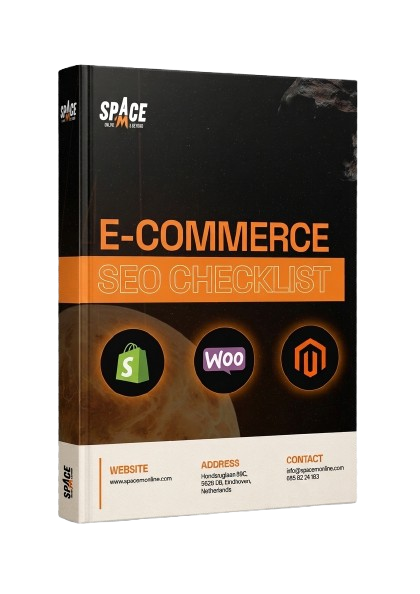
The Shopify SEO audit checklist
Every check on this page in one document: duplicate URL consolidation, faceted navigation control, app-bloat thresholds, theme file locations, and hreflang validation for multi-market stores.
Get the checklist →↑ Back to contents